
Updated: 10/09/2026 — Added a clickable infographic showing seasonal weather patterns and preparation tips.
Universal Orlando weather changes the value of every hour in a park. A 92-degree July afternoon favors a different touring plan than a 72-degree January day. Rain may pause outdoor rides, lightning can affect operations, cold weather can change a Volcano Bay plan, and a tropical system can disrupt an entire vacation. The useful question is not simply, “Will it rain?” It is, “How much flexibility should I build into this trip?”
This guide uses NOAA’s 1991-2020 U.S. Climate Normals for Orlando International Airport, the closest long-term official climate station suitable for a consistent monthly comparison. The numbers are climate averages, not a forecast for Universal Studios Florida, Islands of Adventure, Epic Universe, or Volcano Bay. Check the National Weather Service forecast shortly before leaving and again each park morning.

In This Article
- Monthly weather table
- Best months for weather
- Season-by-season strategy
- Month-by-month advice
- Rain and lightning
- Heat and humidity
- Hurricane season
- Weather-related closures
- Park comparison
- What to pack
- Flexible booking
- Weather FAQ
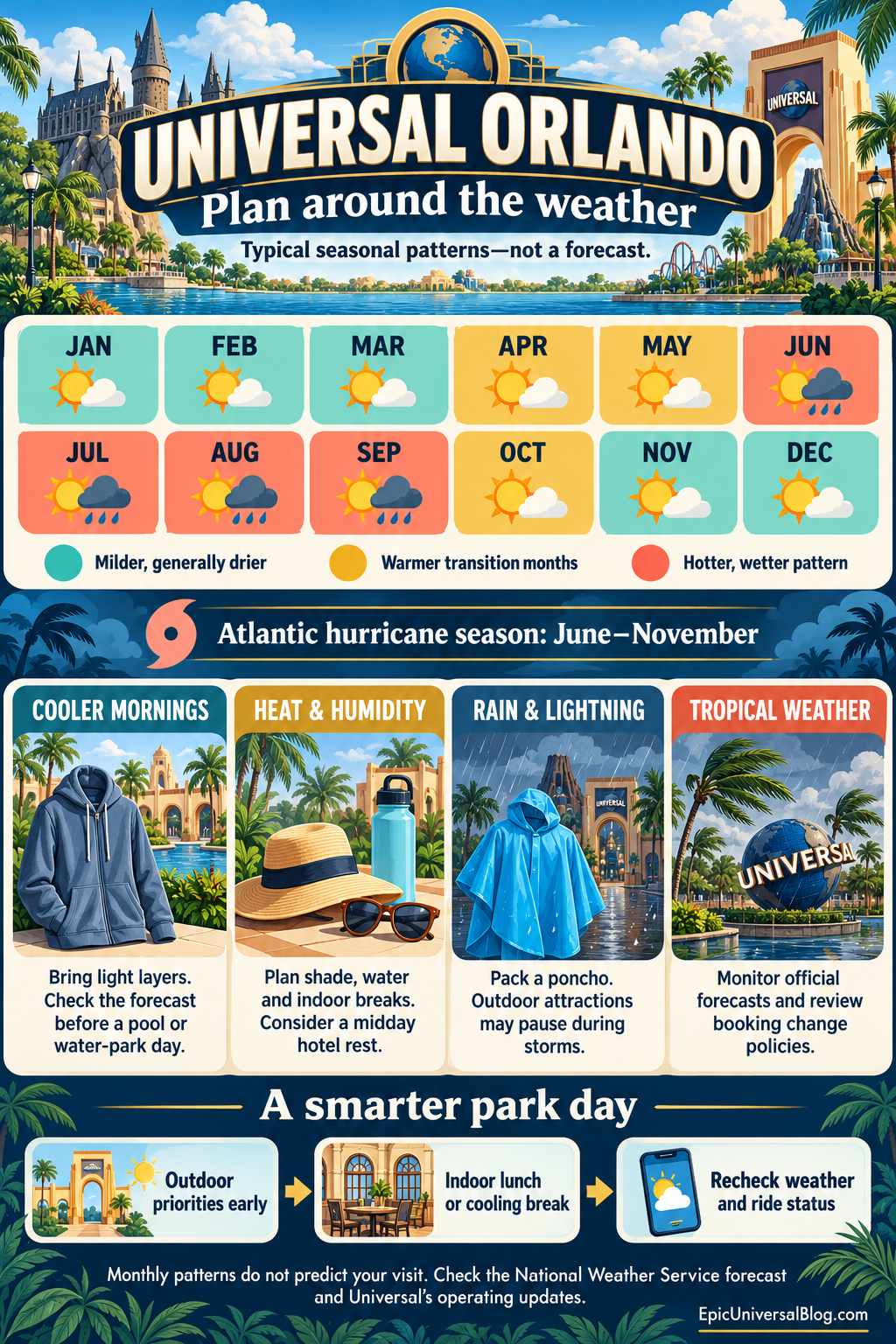
Universal Orlando Weather by Month
The following monthly averages come from NOAA station USW00012815 at Orlando International Airport. “Rain” is the normal total precipitation for the entire month; it does not tell you how many park hours will be wet. Temperatures at the parks can differ from the airport, and pavement, direct sun, humidity, wind, and shade change how a day feels.
Swipe horizontally to compare every column.
| Month | Avg. high | Avg. low | Normal rain | What it means for a park day |
|---|---|---|---|---|
| January | 71.8°F | 49.5°F | 2.48 in. | Comfortable afternoons, but cold fronts can make mornings and nights much cooler. |
| February | 74.9°F | 52.4°F | 2.04 in. | Generally mild with low monthly rain; bring layers for changing temperatures. |
| March | 78.9°F | 55.8°F | 3.03 in. | Warm, often pleasant touring weather; school-break crowds are a separate issue. |
| April | 83.6°F | 60.7°F | 2.58 in. | Warm days without the core summer rain totals; sun protection matters. |
| May | 88.4°F | 66.3°F | 4.02 in. | Heat builds and wet-season habits become useful, especially late in the month. |
| June | 90.8°F | 71.6°F | 8.05 in. | The wettest month by normal total; plan cooling breaks and rain flexibility. |
| July | 92.0°F | 73.2°F | 7.46 in. | Highest normal daytime temperature with high overnight warmth and frequent storm risk. |
| August | 91.6°F | 73.7°F | 7.69 in. | The warmest normal nights; humidity and tropical-weather awareness are important. |
| September | 89.6°F | 72.4°F | 6.37 in. | Still hot and wet; the Atlantic hurricane season reaches its climatological peak. |
| October | 84.7°F | 66.2°F | 3.46 in. | A transition month: early October can feel summery, while later dates may turn drier. |
| November | 78.3°F | 58.2°F | 1.79 in. | Lowest normal monthly rain and comfortable averages, with occasional cool fronts. |
| December | 73.8°F | 52.9°F | 2.48 in. | Mild on average, but wide day-to-day swings make layers more useful than assumptions. |
One important distinction: the “best” weather month is not automatically the best vacation month. Holiday weeks, spring break, special events, park hours, and ticket prices can outweigh a few degrees of comfort. Use our Universal Orlando crowd calendar alongside this table rather than choosing dates from weather alone.
Which Months Have the Best Universal Orlando Weather?
For travelers who value lower humidity, milder afternoons, and lower rainfall, November through March is the strongest broad window. April and late October can also offer a useful balance. Within that range, November stands out in the NOAA normals with a 78.3°F average high and 1.79 inches of monthly precipitation. That does not make every November day dry, nor does it account for Thanksgiving crowds.
Cold-sensitive guests should not treat winter as guaranteed pool weather. Orlando can move from short sleeves to coats within the same trip when a front arrives. Heat-sensitive guests should treat June through September as a different kind of vacation: fewer consecutive outdoor hours, more water and shade, and a hotel break close enough to use. Families tied to summer schedules can still have a strong trip by designing around the climate instead of fighting it.
Universal Orlando Weather by Season
Swipe horizontally to compare every column.
| Season | Main advantage | Main risk | Best planning response |
|---|---|---|---|
| Winter December-February | Mild average afternoons and relatively low rain | Cold fronts, chilly mornings, and large temperature swings | Wear removable layers and keep water-park plans flexible. |
| Spring March-May | Warm temperatures before peak summer rainfall | Increasing heat, strong sun, and busy school-break periods | Start early, protect against sun, and compare crowd dates. |
| Summer June-September | Long vacation schedules and full summer atmosphere | Heat, humidity, heavy rain, lightning, and tropical systems | Prioritize outdoor headliners early, cool down midday, and leave an evening recovery window. |
| Fall transition October-November | Falling rain totals and more comfortable temperatures | Early October heat and remaining hurricane-season risk | Check current forecasts and cancellation terms, especially through November 30. |
Month-by-Month Universal Orlando Planning Advice
January: layers beat a single heavy outfit
January’s average high is comfortable, but its 49.5°F normal low is the coldest in the table. A morning rope-drop outfit may become too warm by lunch, then useful again after sunset. Use a light jacket that fits in a locker or small bag. Do not assume Volcano Bay will fit every January itinerary; review current hours and the forecast before assigning it a fixed day.
February: mild averages with real variation
February combines a 74.9°F normal high with just 2.04 inches of normal rain. That is attractive for long walking days, but a monthly average hides individual fronts. Pack for at least two temperature bands. If a warm spell arrives, the lower humidity can make a full park day feel easier than summer; if a front arrives, an exposed evening wait can feel much colder than the afternoon number suggests.
March: excellent temperatures, separate crowd question
March’s 78.9°F normal high is close to many visitors’ ideal touring temperature. The tradeoff is not primarily climate; it is spring-break timing. Compare school calendars and event dates rather than assuming pleasant weather means light attendance. A compact rain layer still belongs in the bag, and sun exposure becomes more noticeable during long outdoor queues.
April: warm without peak wet-season totals
April has an 83.6°F normal high and 2.58 inches of normal precipitation. This is a strong weather profile for travelers who want warmth without July-level overnight heat. Start sunscreen early rather than waiting to feel hot. Easter timing can change attendance and prices, so pair climate comfort with the date-specific advice in the crowd calendar.
May: prepare for summer before the calendar says summer
May reaches an 88.4°F normal high and 4.02 inches of rain. Early and late May can feel different as the wet season develops. Move exposed coasters and long outdoor walks toward morning, especially at Epic Universe. A midday meal, show, hotel break, or indoor attraction cluster becomes valuable before the biggest summer crowds arrive.
June: the highest normal monthly rainfall
June’s normal precipitation is 8.05 inches, the highest monthly total in this dataset. It also carries a 90.8°F normal high. Build a rain-resilient plan instead of moving the entire trip because a forecast icon shows thunderstorms. Forecast percentages and timing become more useful close to the date. Start with a priority attraction, schedule a cool indoor block around the hardest part of the afternoon, and keep one later window open for anything weather-delayed.
July: the hottest normal daytime high
July’s 92.0°F normal high is the highest in the table. The 73.2°F normal low means the day often starts warm rather than resetting to cool. Treat the first few park hours as premium outdoor time. Alternate sun exposure with air-conditioned attractions, drink regularly, and watch how every member of the group is responding. Our Universal Orlando summer guide helps connect that strategy to current entertainment.
August: warm nights and tropical awareness
August has the highest normal low at 73.7°F and 7.69 inches of normal rain. An evening arrival may still feel humid, so do not save every outdoor priority for night. August also sits within the more active portion of Atlantic hurricane climatology. Review hotel, ticket, airline, and supplier change terms before final payment rather than waiting for a named storm.
September: smaller-crowd potential, peak-season weather risk
September can attract travelers seeking post-summer crowd relief, but the weather tradeoff is meaningful. The normal high remains 89.6°F, normal rain is 6.37 inches, and the Atlantic hurricane season’s climatological peak is September 10. Flexible transportation and booking terms matter more than guessing months ahead whether a storm will form.
October: a transition, not a weather guarantee
October drops to 3.46 inches of normal rain and an 84.7°F average high. Early October can still behave like summer, while later weeks may deliver drier and cooler air. Halloween Horror Nights guests should prepare for warm evenings and occasional rain without bringing a park bag that becomes a burden. Hurricane season remains official through November 30.
November: the lowest normal monthly rainfall
November’s 1.79-inch normal rain total is the lowest of the year, while its normal high is 78.3°F. This may be the best overall climate profile for many travelers. Thanksgiving week can be busy, however, and late-season tropical activity is still possible. Choose November for its broad tendencies, not because dry weather is assured.
December: comfortable averages and holiday crowds
December averages a 73.8°F high and 52.9°F low. Pack layers for mornings and nighttime entertainment, especially when a cold front is forecast. The week between Christmas and New Year’s can be extremely busy, so a pleasant temperature does not remove the need for a priority plan. If staying on-site, compare transportation and room-break convenience in our Universal Orlando hotel guide.

What Happens When It Rains at Universal Orlando?
Universal Orlando usually does not close an entire theme park merely because rain begins. Indoor attractions, dining, shops, and some entertainment may continue, while lightning, wind, heavy rain, flooding, or other conditions can affect exposed rides and shows. Operational decisions are attraction-specific and can change quickly. Universal’s rider-safety information states that parks, attractions, or entertainment may close because of weather without notice.
Do not rely on the popular claim that every Florida storm ends in 20 minutes. Some showers are brief and localized; others last for hours or produce repeated lightning. A better plan has three layers: an outdoor priority list, a nearby indoor fallback, and a later recovery window. If the outdoor attraction reopens, you know what to move. If it does not, the day still contains worthwhile experiences.
A practical rainy-day sequence
- Check the current NWS forecast and Universal app before leaving the hotel.
- Ride the most important outdoor attraction early if it is operating.
- When weather approaches, move toward an indoor attraction cluster, show, or meal instead of crossing the park.
- Watch official app updates and attraction entrances; do not use social posts as the final operational source.
- After conditions improve, reassess wait times rather than automatically returning to the original plan.
- Keep one evening or later-trip slot available for a weather-missed priority.
How to Handle Universal Orlando Heat and Humidity
Heat changes more than comfort. It can slow the group, reduce appetite, worsen existing health conditions, and turn a long walk between portals into the hardest part of the day. The National Weather Service heat-safety guidance notes that anyone can be vulnerable, with young children, older adults, pregnant people, and people with chronic conditions among groups at higher risk.
Use the forecast heat index, not the air temperature alone, when judging the day. Start hydrated, drink regularly, use sun protection, choose breathable clothing, and schedule air-conditioned time before someone feels unwell. A resort hotel can be a practical weather tool: a midday room break is much easier when transportation is short. If anyone develops concerning symptoms, stop touring and seek appropriate help; this guide is not medical advice.
Put the longest exposed walks in the morning
Epic Universe is large, and moving between portals adds sun exposure that a ride list may not show. Study the Universal Orlando park maps and group nearby experiences. At Islands of Adventure, avoid repeatedly circling the lagoon. At Universal Studios Florida, use indoor attractions and dining as intentional cooling blocks. The goal is fewer unnecessary crossings, not simply fewer rides.
Should You Avoid Universal Orlando During Hurricane Season?
Not automatically. The National Hurricane Center defines Atlantic hurricane season as June 1 through November 30. Its climatological peak is September 10, with most activity from mid-August through mid-October. Those are basin-wide patterns, not a forecast that Orlando will be affected on a particular date.
A hurricane-season trip needs better terms, not panic. Read cancellation and change rules for the hotel, tickets, airline, rental car, and every third-party supplier. Keep confirmation numbers accessible. As the trip approaches, use the National Hurricane Center and local NWS office, not a viral model screenshot, for official information. If authorities or Universal issue instructions, follow them.
What Universal’s severe-weather policy covers
Universal’s current severe-weather policy says that a hurricane or tropical-storm warning, or a state of emergency, within seven days of arrival may allow certain direct Universal vacation packages, hotel-only reservations, and tickets to be rescheduled or canceled without Universal-imposed fees. Terms, exclusions, and booking-channel differences apply. A forecast cone by itself is not the same as satisfying the policy.
If you booked through a third party, Universal directs you to that supplier. That includes affiliate purchases: save the supplier’s confirmation and support details, and review the terms shown before checkout. Airlines, group travel, event products, and other components may have separate rules. Never assume one company’s hurricane policy changes another company’s contract.
Which Universal Orlando Attractions Close for Weather?
Universal does not publish a permanent consumer list promising exactly which attraction closes at a particular lightning distance, wind speed, or rainfall amount. Outdoor coasters, water rides, outdoor shows, and other exposed experiences may be affected, but operations depend on current conditions and safety procedures. Check the Universal Orlando app and the attraction entrance for the current decision.
Do not build a plan around a guessed reopening time. When a priority closes, note its location and switch to the nearest worthwhile indoor option. If it returns later, compare its wait against the rest of the day. A closure can sometimes concentrate guests indoors, so a “rainy-day attraction” may gain a longer line. Weather flexibility works best when the group has several acceptable choices.
Which Universal Park Is Best in Bad Weather?
Swipe horizontally to compare every column.
| Park | Weather advantage | Weather limitation | Useful strategy |
|---|---|---|---|
| Universal Studios Florida | Several substantial indoor attractions, shops, and dining locations | Outdoor entertainment and some rides can still be affected | Cluster indoor options, then return to outdoor priorities when conditions allow. |
| Islands of Adventure | Strong indoor headliners and covered areas in several lands | Outdoor coasters, water rides, and lagoon travel expose the plan | Avoid unnecessary full-lagoon loops; keep a fallback in the same island. |
| Epic Universe | Every portal includes indoor experiences and dining | Longer inter-portal walks and multiple outdoor headliners increase exposure | Finish a portal cluster before crossing Celestial Park when weather is near. |
| Volcano Bay | Heat can make a water-park day appealing | Lightning, cold, wind, and severe weather can have a larger effect on the day | Check same-day hours and conditions; keep a theme-park or CityWalk alternative. |
No park is weatherproof. Universal Studios Florida is often the easiest to reshape around indoor experiences, but the best choice depends on which attractions are operating and what your group values. Review our detailed Universal Studios Florida guide, Islands of Adventure guide, and Epic Universe guide before building the fallback list.

What Should You Pack for Universal Orlando Weather?
- Year-round: comfortable broken-in shoes, refillable water bottle, sun protection, and a phone power source.
- Wet season: compact poncho or rain jacket, quick-drying clothing, and a resealable waterproof pouch for items that must stay dry.
- Hot months: breathable clothing, a hat that can be secured, and a planned cooling schedule.
- Cool months: removable layers rather than one bulky coat, especially for early entry and nighttime shows.
- Volcano Bay: secure swimwear, water-friendly footwear, dry clothes, and a weather-flexible backup plan.
- Hurricane season: supplier contact information, confirmation numbers, necessary medications, and a small travel buffer when possible.
Keep the bag manageable because attraction locker rules still apply. Review Universal’s current policies and restrictions and theme-park services before packing. Weather preparedness should make the day easier, not create an oversized bag that slows security and locker stops.
How Weather Should Affect Ticket and Hotel Decisions
A single-day ticket concentrates weather risk: one stormy afternoon can affect a larger share of the purchase. A multi-day itinerary creates recovery windows, but only if the ticket actually covers the parks and dates you intend to use. A nearby hotel can add a practical midday break. It may also cost more, so compare the complete trip rather than treating weather resilience as a reason to overbuy.
Ticket-only works for travelers who already have lodging and transportation. A hotel-and-ticket package may be useful when a midday room break or bundled trip support is part of the weather strategy. Read the supplier’s change and cancellation terms, especially during hurricane season, before paying.
Compare Universal Orlando tickets Compare hotel + ticket packages
Universal Orlando Weather FAQ
What is the best month for Universal Orlando weather?
November has a particularly favorable climate profile in the 1991-2020 Orlando normals: a 78.3°F average high and the year’s lowest normal monthly rain total, 1.79 inches. February through April can also be comfortable. Crowd levels, prices, and events must be compared separately.
What is the rainiest month at Universal Orlando?
June has the highest normal monthly precipitation at Orlando International Airport, 8.05 inches, followed by August at 7.69 inches and July at 7.46 inches. These are monthly climate totals, not a prediction of how many park hours will be rainy.
What is the hottest month at Universal Orlando?
July has the highest normal average high at 92.0°F. August has the warmest normal average low at 73.7°F. Humidity and direct sun can make conditions feel hotter than the air-temperature number.
Does Universal Orlando close when it rains?
The entire resort does not normally close for ordinary rain, but attractions, entertainment, or parks may close because of weather. Lightning, wind, heavy rain, and other conditions can affect operations. Check the Universal app and follow Team Member directions.
Do Universal Orlando rides run during thunderstorms?
Do not assume outdoor rides will operate during a thunderstorm. Universal makes real-time safety decisions and does not promise a fixed public closure list or reopening time. Move indoors when instructed and check official operational updates.
How long do Florida afternoon storms last?
There is no reliable universal duration. Some storms are brief and localized; others persist or redevelop. Build an indoor fallback and later recovery window instead of counting on a storm ending after a certain number of minutes.
Should I bring a poncho to Universal Orlando?
A compact poncho is useful year-round and especially from May through October. It keeps both hands free and packs small. It does not provide lightning protection, and all loose-article rules still apply at attractions.
When is hurricane season at Universal Orlando?
The Atlantic hurricane season officially runs from June 1 through November 30. The climatological peak is September 10, with most basin activity from mid-August through mid-October. That pattern cannot predict a storm on your travel dates.
Will Universal refund tickets for a hurricane?
Universal’s severe-weather policy may allow qualifying direct bookings to be changed or canceled without Universal fees when specified warning or emergency conditions occur within seven days of arrival. Terms and exclusions apply. Third-party customers must contact the original supplier.
Is Universal Orlando cold in winter?
Winter is mild on average, but cold fronts can produce chilly mornings and evenings. January’s normal low is 49.5°F. Pack removable layers and make water-park plans based on the current forecast rather than the monthly average.
Is Volcano Bay open in cold weather?
Hours and operations can change with season and weather. Check Universal’s current calendar and same-day information. Keep an alternate theme-park, hotel, or CityWalk plan if the forecast is too cold or operations change.
How far ahead can I trust an Orlando weather forecast?
Long-range outlooks show broad tendencies, not hour-by-hour park conditions. Use climate normals for choosing a season, then shift to the National Weather Service forecast as the trip approaches. Recheck each morning because storm timing can change.
Methodology and Official Sources
Source credit: Official NOAA, National Weather Service, National Hurricane Center, and Universal Orlando sources checked for this guide. Monthly values are the 1991-2020 normals for Orlando International Airport station USW00012815. The NWS Melbourne normals page explains that climate normals are 30-year averages, while NWS Melbourne climate resources direct users to NOAA data for official records. Normals describe climate; they do not forecast a specific Universal Orlando day.
- NOAA NCEI Orlando monthly normals data
- National Hurricane Center tropical cyclone climatology
- National Weather Service lightning safety
- National Weather Service heat safety
- Universal Orlando severe-weather policy
- Universal Orlando rider safety and weather notice
- Universal Orlando policies and restrictions
What month are you visiting, and is heat, rain, or cold your biggest planning concern? Add your dates and priorities in the comments so we can keep improving this guide without pretending a long-range average is a personal forecast.
About the Author
Mark is the editor of Epic Universal Blog, an independent Universal Orlando planning and news site. He checks current official resort information and turns it into practical trip decisions. Learn more about Epic Universal Blog.